Excel For Mac Group Outline Summary Below Detail
Outline the outer group. How to outline the outer group. Select all of the subordinate summary rows and their related detail rows. For example, in the data below, row 6 contains the subtotal for rows 2 through 5, and row 10 contains the subtotal for rows 7 through 9, and row 11 contains the grand total. These are part of Excel’s Group and Outline feature, which you can use separately from Scenario Manager. The Outline button is also on the ribbon’s Data tab, all the way on the end. Click any of the minus signs to collapse the sheet so it shows only summary data, or click the plus signs to expand and show detail. Microsoft Office Excel 2016 for Mac Introduction to Charts. On the Insert tab, go to the Charts group. Figure 5 - Charts Group 3. Use the Shape Fill, Shape Outline, and Shape Effects buttons to make changes to the text box. Applying a Pre-Defined Chart Layout.
• Click the 2 button at the top of the new margin to expand all groups. You can select a range of adjacent rows within a single table and on the Ribbon’s Data tab; go to the Group & Outline group and choose Group→Group to group just the selected rows. To ungroup, go to the same Group & Outline group on the Data tab and choose Ungroup→Ungroup or Clear Outline.
For more information, see the sections. • Hide the detail by clicking the outline symbols,, and to show only the totals as shown in the following example of a row outline: • For more information, see the section,.
Note: To outline data by columns, you must have summary columns that contain formulas that reference cells in each of the detail columns for that group. • Specify whether the location of the summary column is to the right or left of the detail columns. On the Data tab, in the Outline group, click the Outline dialog box launcher.
• On the Data tab, in the Outline group, click Group. The outline symbols appear beside the group on the screen. • Continue selecting and grouping inner columns until you have created all of the levels that you want in the outline.
On Aug 20, 7:10 pm, Dave Peterson wrote: > Data Group and Outline Settings > Uncheck that Summary Rows below detail > > wrote: > > > I want to use the group and outline functionality to group sets of > > rows, but instead of the bottom row of the group showing when I > > collapse the group, I want the top row to show. This is because each > > of the items below the top row are the elements of the group and the > > top row is the header. > > > Can this be done with the Excel grouping functionality? > > > Thanks. > > -- > > Dave Peterson Thanks Dave! 13c.@gmail.com 7/10/2015, 6:28 น.
How to outline the outer group (all the columns except the grand total) • Select all of the subordinate summary columns, as well as their related detail data. In the example below, column E contains the subtotals for columns B through D, and column I contains the subtotals for columns F through H, and column J contains the grand totals.
How do I do that in a formula and not manually? I found another similar thread and I understand how to do it from the instructions there but the same text goes on the back and the result is: 34DF but I need it to be like: DF34. I am using Office 2007 for mac. Thank you for the help, Chris. I have a Workbook with 2 sheets, the first one is the data entry and the second one contains all the calculations and confidential info. I have one staff member that does the data entry but I don't want them to see the 2nd sheet. I know I can hide the sheet then protect the entire workbook which does work, but is there an easier way so that the second person doesn't have to keep hiding/unhiding the 2nd sheet?
> > > > This property has no effect in Windows, but its value is retained (it can be > > set and returned). > > Surprisingly (at least to me), the property doesn't even show up in the > property list in XL03/VBA Help, though it is listed in the Object > Browser. From xl2002 VBA's help for outlinefont: Remarks This property has no effect in Windows, but its value is retained (it can be set and returned). JE McGimpsey wrote: > > Actually, no. I ran this macro on a workbook in XL03: > > Sub Outline() > Selection.Font.OutlineFont = True > End Sub > > and the when I opened the workbook in XL04, the selection showed up as > an outline font.
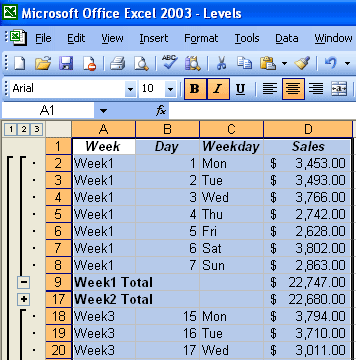
Notice how the margin has a 1 and 2. This indicates that there is a single level grouping.
Notes • When function_num is between 1-11, SUBTOTAL includes values that are hidden • When function_num is between 101-111, SUBTOTAL excludes values that are hidden • In filtered lists, SUBTOTAL always ignores values in hidden rows, regardless of function_num. • SUBTOTAL ignores other subtotals that exist in references are ignored to prevent double-counting • SUBTOTAL is designed to work with vertical data values arranged vertically. In Horizontal ranges, values in hidden columns are always included.
Select any other options that you want. • Clear the Replace current subtotals check box.
All help is appreciated. Hello I'm quite experienced Excel user.
• Next, enter the worksheet title Mother Goose Enterprises – Total Projected Income 2014 in cell A1. Do this by selecting cell A1 and then typing the text. • Finally, copy the rest of the row headings for column A (containing the revenue and expense descriptions) from the Sprat Diet Ctr worksheet to the Total Income worksheet. To do this, select cell A3 in the Total Income sheet and then click the Sprat Diet Ctr tab. Select the cell range A3:A22 in this sheet; then press Ctrl+C, click the Total Income tab again, and press Enter. You are now ready to create the master SUM formula that totals the revenues of all nine companies in cell B3 of the Total Income sheet: • Start by clicking cell B3 and pressing Alt+= to select the AutoSum feature.
- Installer and updater file name format change. For example, Microsoft_Office_2016_1300_Installer.pkg instead of Microsoft_Office_2016_15.28.0_161113_Installer.pkg. Microsoft AutoUpdate Includes a new option to automatically detect, download, and install updates. - Version number updated to 3.8.1.
In the outline numbering dialog box I have checked the box for 'restart numbering after' for each of the levels 2, 3, and 4, and saved this in the template. For level 2, the outline numbering does not start after level 1. However, for all subsequent levels, the outline numbering does start correctly. The box is correctly checked when I go in to review the settings for my outline numbering. I have tried to uncheck and sa.
• In the At each change in box, click the nested subtotal column. For example, using the example above, you would select Sport. • In the Use function box, click the summary function that you want to use to calculate the subtotals. For example, using the example above, you would select Sum.
For example, to create the Apples group within the East region, select rows 2 and 3, and hit Group. To make the Oranges group, select rows 5 through 7, and press the Group button again. Similarly, we create nested groups for the North regions, and get the following result: 3. Add more grouping levels if necessary In practice, datasets are seldom complete. If at some point more data is added to your worksheet, you will probably want to create more outline levels.
Re: Hex incrementing for MAC addresses - Easy fix Hey Guys! I know this is an old thread but a really easy fix I found to incrementing is to convert the MAC address to a decimal, add 1, and convert it back to a Hex. All columns will be auto-filled at once by pressing 'Ctrl+D'. This is a very useful shortcut if you use excel a lot. Please let me know if there is an issue. Tip: If you are looking for a more advanced auto-numbering system for your data, and Access is installed on your computer, you can import the Excel data to an Access database. In an Access database, you can create a field that automatically generates a unique number when you enter a new record in a table. Auto increment number in excel for mac 2013.
Also, is there a way to pull out of Excel what is the current User's 'Options General Default File Location' entry? Which may differ from the above directory. I am familiar with and use the following coding for Opening/Saving files to the current directory of the opened workbook, but it only gives the path of the existing Excel workbook and not the current User's Directory Path: Dim wbThis As Workbook Set wbThis = ThisWorkbook ChDir wbThis.Path.
Cells in rows containing a sub heading in column E have a checkbox in column A, and the formula below in column B: IF(A$2,'show',') Cells in rows containing a sub-sub heading in column E contain the same formula, with the cell reference changed to name the cell in the row containing their category. The example below, controlled by the 'Screen' checkbox in A6, shows the formula in B7, B8, and B9: IF(A$6,'show',') With the filter turned off to show all rows, column B unhidden, and the Laptop and Screen checkboxes checked, the table looks like this.And with the same boxes checked and the filter turned on, like this: Regards, Barry. Hi Dave, Here's a sample, based on your table posted above.
>> On Thursday, February 26, 2009 6:03 AM Davesexce wrote: >> That's interesting, >> do stairs go up, or do they go down? Pravin_sn 4/4/2011, 3:13 น.
Add visual impact: Insert and edit Scalable Vector Graphics (SVGs) in your presentations to add visual interest and retain a high image quality. Outlook Add visual impact: Insert and edit Scalable Vector Graphics (SVGs) in your emails to add visual interest and retain a high image quality. A more actionable calendar: Click any meeting or event in your calendar to see all of the associated details. Check out who is invited, edit your response, or join the meeting, all in one place. Easier scanning of search results: Outlook highlights your search term in the item list or Preview pane. Week numbers: Week numbers are now displayed in Calendar month view and mini-calendar in the sidebar.
Outlining and grouping rows or columns in makes it easy to organize and declutter spreadsheets that have a ton of data on display. Say you have several rows with the sales figures by month and the last row is a summation of the data, rather than display all months you can group the data (months) and only display the row with the totals. This can be extremely useful when you are working with a spreadsheet that has multiple years of data, think of it, if you had 7 years of data by month – that would amount to 84 rows of months and 7 with totals instead of dizzying someone with all that data you can group it and display the totals per year and show off your skills with Excel. If you have any comments or questions please post them below. Note: I used Excel 2007 when creating this tutorial.
Animation Triggers are here: You asked for it! Animation triggers aren't just for Windows anymore. Find them on the Animations tab. Outlook Improved Search: Select the Search box for quick suggestions based on your recent search history. No typing required.
To group columns F through H, which has a summary row I, select columns F through H. A B C D E F G H I J 1 Regn Jan Feb Mar Q1 Apr May Jun Q2 H1 2 East 371 504 880 1,755 186 653 229 1,068 2,823 3 West 192 185 143 520 773 419 365 1,557 2,077 4 North 447 469 429 1,345 579 180 367 1,126 2,471 5 South 281 511 410 1,202 124 750 200 1,074 2,276. Important: Do not include the summary column for that group in the selection.
If (thisOne = thatOne) Then ' if the cells are equal, the line count is added to the subcount subCount = subCount + ActiveCell.Offset(0, 1).Value Else ' if the cells are not equal, the subcount is written, and subtotal reset. ActiveCell.Offset(0, 2).Value = ActiveCell.Offset(0, 1).Value + subCount subCount = 0 End If ' select the next cell down ActiveCell.Offset(1, 0).Select ' assign the values of the active cell and the one below it to the variables thisOne = ActiveCell.Value thatOne = ActiveCell.Offset(1, 0) Wend End Sub.
The real catch is that the workbook has macros. I used the 'Share Workbook' function under tools. At the end of the setup, it told me that the macros would not work properly. The odd thing is that everytime I try to click on one of the macros I get an error, but yet the macro still performs the function. So essentially the macro works, it is just a pain because you have to click 'end' everytime on the error screen. Any suggestions?
The default was always set to copy everything (including hidden cells), unless I specifically selected copy visible cells only. In 2007, the default is somehow set to always copy only visible cells.
You can have up to 8 levels of grouping. Ungrouping Rows 1. Make sure you select the groups that you wish to ungroup, do this by selecting the rows or columns that are grouped. Click on the Data tab located in the Ribbon. Click on the Ungroup button located in the Outline Group 4.
This is adding up these three cells, same thing over here, I also got some grand totals over on the right. We have some totals also adding up data from above like this is adding data from the two cells here.
Flag icons show where others are working and you can view changes as they type. We save for you! Changes are saved automatically for documents, worksheets, and presentations stored in the cloud, and you can see others' updates in seconds. Need to roll back?
They are all listed one after another in date order. Can anyone >suggest how to get it back?
In the past I have use this code to acheive similar results: Dim endRow As Long endRow = Cells(Rows.Count, 'B').End(xlUp).Row Range('C2').AutoFill Destination:=Range('C2:C' & endRow) The problem with this code is that I will not always be starting in 'C2'. I need code that uses whatever the selected cell is.
Is there a quick fix to this? Or do I need to put the filter item in every row within the groups in the data set? Thanks in advance for your help.
In this video, we'll look at shortcuts you can use to group, ungroup, and work with outlines. In this worksheet, we have some basic data subtotaled by region and quarter. The shortcut for grouping rows or columns in Excel is Alt Shift right arrow in Windows and Command Shift K on a Mac. If you only have cells selected (not entire rows or columns) this shortcut will cause Excel to display the Group dialog box.
You can make blank cells empty by selecting them and pressing the delete key, but I need a fast way to do this on all blank cells in a large worksheet. The only way I have found is with a VBA macro that loops through every cell, tests for '.Value = ' ' and then uses the '.Clear()' function, but doing this on 30 columns x 10000 rows is far too slow. Any solutions? (The reason I need to do this is for importing into Access, the database treats empty cells as NULL which is what I want. Blank (but not empty) cells screw the import process up.). Hello - I am using Excel 2007. In prior versions of excel, when copying data, if I wanted to copy visible cells only, I would select 'Go To, Special, Visible Cells Only' and then copy a range a cells.
This is a task that I have done before, but not for some time. I have a spreadsheet that has subtotals under the detailed data throughout the sheet.
Note • For a list of all Office for Mac releases and additional download links, see. • If you're an Office Insider, see. • Starting with the 16.17 release in September 2018, these release notes also apply to Office 2019 for Mac, which is a version of Office for Mac that’s available as a one-time purchase from a retail store or through a volume licensing agreement. But, some features listed in the release notes are only available if you have an Office 365 subscription. • The release notes for version 16.16 and earlier also apply to Office 2016 for Mac, which is also a version of Office for Mac that’s available as a one-time purchase.
This is how you group rows in Excel to collapse or expand certain sections of your dataset. In a similar fashion, you can group columns in your worksheets.
To add subtotals in a table, you must first convert the table to a normal range of data, and then add the subtotal. Note that this will remove all table functionality from the data except table formatting. Or you can create a. When you insert subtotals: • Subtotals are calculated with a summary function, such as Sum or Average, by using the SUBTOTAL function. You can display more than one type of summary function for each column.
Apple may provide or recommend responses as a possible solution based on the information provided; every potential issue may involve several factors not detailed in the conversations captured in an electronic forum and Apple can therefore provide no guarantee as to the efficacy of any proposed solutions on the community forums. Apple disclaims any and all liability for the acts, omissions and conduct of any third parties in connection with or related to your use of the site. All postings and use of the content on this site are subject to the.
The outline symbols appear beside the group on the screen. • Optionally, outline an inner, nested group (individual groups of detail columns). How to outline the inner, nested group (Groups of detail columns) • For each inner, nested group, select the detail columns adjacent to the column that contains the summary column. In the example below, to group columns B through D, which has a summary column E, select columns B through D.
In prior versions of excel, when copying data, if I wanted to copy visible cells only, I would select 'Go To, Special, Visible Cells Only' and then copy a range a cells. The default was always set to copy everything (including hidden cells), unless I specifically selected copy visible cells only. In 2007, the default is somehow set to always copy only visible cells. Sometimes, I want to be able to copy all cells including those hidden but cannot seem to figure out how to swith this default option. I looked under Excel Options and did not see an option there.
The question: How can you prevent a cell's contents from overflowing into the next cell? Of course, you can make the column wider or turn on text wrapping, but you might not want to. Each of those solutions can mess up the layout of your sheet. You may just want to truncate the value. Some people have suggested putting a space in the next cell. This is unnecessary, a pain in the but, and will mess up any ISBLANK type formulas, among other things.